Pages

Search This Blog

Sunday, April 29, 2012

After having a few weeks to work on the previous exercises, here is a new set for you to try!

Circuit 1- 3 sets ogf 30-60 seconds each

Plank with Alternate Knee Touch (off elbows)
Plank - Updowns (elbows to hands and back down)
Plank Reach- (Choose hands or elbows)

Circuit 2- 3 sets of 30-60 seconds each


Single Leg Bridge (Double leg if Single leg is too hard, toes up heels down)

Bulgarian Split Squats- Foot on edge of bench or couch, drop straight down, do not let knee move forward in front of toes
Bulgarian Split Squat Hold- Hold above position for selected time


*Always consult with a physician before starting an exercise program.


Sunday, April 8, 2012

Post Easter Burn

Post Easter Burn

Circuit 1:  Repeat 3 times through for 30-60 seconds

Single Leg Bridge -Repeat lifting up and down with a 2-3 second hold at the top on one leg
Lateral Hop- Hop with a single leg landing from side to side.  Land on the same side leg you are jumping towards and try not to let the other leg touch the floor.  The farther the hop, the more difficult the exercise.- No picture


Russian Twist-  Sit back to a 45 degree angle, with knees bent and feet on the floor.  Rotate side to side with the arms stretched forward, as far as possible with each turn.  Working through the full range of motion is more important than speed.

Circuit 2: Repeat 3 times through for 30-60 seconds

Single Leg RDL- Keeping head, back and leg in straight line, tip forward until pull is felt on hamstring of planted leg.  Return to standing position.  Stay on pone leg for full amount of time before switcheing to the other.


Split Squat- Place one leg forward and one leg back.  Squat towards the floor.  Weight should be on  the front leg heel so knee doesn't go past the front toe.  Return back up to starting position.

Venom- Plank position and touch alternate knee to alternate elbow alternating sides.


*Consult with a physician before starting any exercise program.

Tuesday, April 3, 2012

A special Thank You to Breakthrough Physical Therapy in Irvine (www.breathroughphysicaltherapy.com) for these photos.


Circuit 1: 
Plank with Alternate Knee Touches- Plank position and lower one knee to the floor without rotating the spine.  Alternate touching knees for the selected time.
Single Leg Bridge- Lie on back with toes up (biases buttock muscles)  and heel down.  Lift opposite leg up and hold in air.  Push through heel and lifting buttocks from floor.  Hold 2-3 seconds and lower.  Repeat.  Back pain?  Try using both legs instead of one to lift buttocks up and down.
Alternate Lower Extremity (Leg) Extension-  Lie on back with both knees up and bend to 90 degrees.  Lower one leg down towards floor and return to starting position.  Alternate lowering legs. Maintain a quiet spine and do not let back arch. Hold arms overhead to increase difficulty.


Circuit 2:
Plank with Hip Circles - The picture below demonstrates the proper position for both.  With the circles, perform a tight circular motion either forwards or backwards with the knee without any rotation through the back.


Plank with Firehydrant-  With the knee bent on one side raise and lower the knee out to the side without rotating the back.
Plank with Glute Press-  Bend you knee and press up towards the ceiling with one leg.  Pulse the heel up and down without rotating the back.


Perform each exercise 3 sets through for 30- 60 seconds.
Want to change it up!? You may chioose to do a hold in that position rather than alternate position.

Please consult with a MD before starting a new workout routine.

Sunday, March 25, 2012

Circuit 1:
Perform exercises 3 rounds of 30-60 seconds per exercise

Double Leg Hold 6" above ground (legs up higher= easier)
V- Ups (double leg lower with arms ove head, reach up and touch toes)
Figure 8s (double leg hover making the 8 sideways like an infiniti sign)
Plank Venom  Plank off of hands, holding this position touch opposite knee to opposite hand, banck will bend slightly.

Circuit 2:
Perform exercises 3 rounds of 30- 60 seconds for each exercise

Quadriped= Hands and knees
Quadriped Hip Circles (nice tight circles without back movment, alternate directions forward or backward each round)
Quadriped Firehydrant (raising knee out to side, do not let back move)
Quadriped Glute Pulse (pressing one leg up towards the sky keeping the knee bent at 90 degrees and not letting back rotate, continuous pulse at end of motion)
Swimmers (lie on stomach and raise the opposite arm and leg up to the ceiling, hold 2-3 seconds and alternate sides, if your back hurts try putting a couple pillows underneath your stomache)

Please do not perform exercises through pain and without the consent of a physician.

Sunday, March 18, 2012

Little time for core training?  Want to supplement your workout?  No worries.  This blog will now start posting a short core workout every week.  The exercises should take no more than 9-18 minutes and are meant to be performed 3-4 times a week.  Please send me a message if the exercise is confusing or painful and if you want to know how to alter it for your level.
Perform each exercise 1 time through for 30-60 seconds (low-high level).  Rest 30-60 seconds and perform each set of three exercises 3 times through.  Enjoy and share with your friends!

Circuit 1
1. Crunches- chin tucked and arms reaching straight up to the cieling.  Shoulder blades do not touch the floor if possible

2. Plank- off elbows and knees (low level) hands and toes (high level)

3. Bridging- Double leg (lower level) and single leg (higher level) buttock lifts off of floor from back with toes UP.  Raise and lower slowly.


Circuit 2
1.  Single leg alternate lower (the lower the leg goes, the harder the exercise)  Lie on back, raise both legs up to 90 degrees, hold one still and drop the other.  Alternate slowly keeping back still.

2.  Double leg squat hold.  *Knees must stay over web space, place more weight on outside of foot if they fall in over big toe.  Bend forward at the waist to activate hamstrings and glutes more and decrease ACL strain.*  Stay in squat position the whole time.

3.  Lateral lunges.  *Again pay close attention to knee position- see above.  Continue to alternate sides during time.

Total workout time 9-18 minutes depending on 30 second-60 second rounds.

Always consult a physician before starting a program.

Check in next week for new list of exercises and give me feedback as to what types of exercises you want.  This blog will start adding higher intensity activities as the weeks progress.

Thursday, January 19, 2012

NFL Combine Core Training- week 2

     I learned an interesting piece of information from the offensive linemen this week.  I was informed during their drill training they are taught to turn their feet out while squatting down.  I am not an O-Line coach and, therefore, am not here to change the mechanics needed for their job, but this does answer why consistently every year we find hip abduction (raising the leg out to the side) and hip external rotation (turning the knee out) weakness in just about all of the players we test.  This weakness leads to poor cutting and blocking positions which sets the player up for injury.  Nothing is more devestating than when a player tears an ACL or blows a disc in the back requiring months of rehabilitation and time away from play.


My job as the core coach is to teach these players how to turn on the muscles at the appropriate time to provide stability and increase their durability.  When exercises are performed quickly, it is easy for the body to "cheat" in order to accomplish the task.  To address the above stated hip weakness, NFL Combine Core training this week focused on hip abduction and external rotation strength.  By adding a miniband to the legs with various exercises (see photos below for example) we created a focus on hip stability and strength through various challenging positions. By slowing down the core exercises to a 3-5 count/hold, we further increased the control and contraction requirements of the muscles.  Remember, this training is in addition to all of the on field drills and weight training/ conditioning they do on a daily basis, so there is enough explosive training throughout the rest of the day to train the appropriate power system needed for play.  If I can provide the right neuromuscular control when a player gets hit and cut to protect a spine or a knee, I have done my job and exponentially increased the player's worth.

Tuesday, January 10, 2012

Diaphragmatic Breathing and Thoracic mobility


     This was the 1st week of the NFL Combine training and core training started from the beginning.  That means the main focus was diaphragmatic breathing with proper abdominal contraction and throacic mobility.  The diaphragm forms a pliable dome at the top of the core (see picture from last blog).  While the diaphragm's primary job is to help with respiration (ie the exchange of O2 for the body) it is also a powerful stabilizer.  Teaching athletes the art of proper breathing is imperative to creating maximal core stabilization. 
      Thoracic (midback) and rib mobility can also be improved by practicing diaphragmatic breathing.  Deep breathing increases rib expansion and thoracic flexion and extension.  Slumping forward from daily activities increases back stiffness and decreases the overall rib and throacic mobility.  This can lead to many problems such as back, shoulder and neck pain as well as headaches.  Breathing properly with stretching will reinforce low back stabilization and increase thoracic mobility.
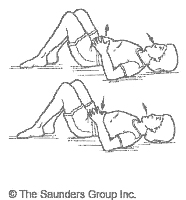
     In order to assess your breathing, lie on your back placing one hand on your chest and one hand on your belly.  Take 4-5 deep long breaths.  Which hand moves more?  For proper breathing, breathe deeply down into the stomache moving that hand upward.  The hand on the chest should barely, if not, move at all. 
     Once you can breathe deeply into the stomache comfortably, try adding in breathing to abdominal exercises such as lower leg lowers or crunches or upper body exercises like bench and military presses.  To add breathing to abdominal exercises, the concentric part of the exercise should be performed on the exhale (breath out).  For instance, breathe deeply in and on a slow exhale lower the legs or crunch up.  Feel the abdominals and back tighten as more and more air is expelled out of the lungs.  This increases back stability via an abdominal brace without having to "flatten" the back.  As you breathe in the legs would raise back up or if crunching, the shoulders would lower.  Controlling the pace of the exercise with slow breathing improves the quality of the exercise and maximizes the strength gains.

Monday, January 2, 2012

CoreTraining: The Importance of Fundamentals

      Too often I have patients asking me what is the one exercise that will strengthen the core. Due to the complex nature and importance of the core in various activities and postions, it is impossible for me to answer that question with one exercise.  Every individual, whether they are an athlete or not, requires training of BOTH the postural stabilizers and the power producers.  Not only do we need to address both types of muslces, but in various positions and planes.  I look at many core training programs and am disappointed to find not enough physical therapists are challenging their patients with power exercises for fear of harming them and not enough personal trainers and strength coaches returning to the fundamentals and starting their athletes with the basics.    We need to be identifying weaknesses in all populations and building a solid program that teaches the fundamentals first and progress from there.

     The core is defined in various ways in the literature, but the basic premise is that it forms something close to a cylinder in the central part of the torso.  The bottom is the pelvic and hip muscles, the front are the abdominals, the back is the lumbar muscles and the top is the diaphragm.  Some of the researchers have categorized individual muscles as local versus global muscles, while others have described them as the stabilizers (postural muscles) versus the mobilizers (power muscles).    No matter how they are described, it is important that we train both.  One group cannot function to its full capability with weakness in the other.  Just as beginning with a white color belt in martial arts is required before training to test for another color, we should be doing the same with all our clients/ patients.  Breathing and proper abdominal contraction must be addressed and mastered before moving on to more advanced exercises.


     Screening the high level athletes that come through our doors at Breakthrough Physical Therapy in Irvine, CA, only reinforces the "return to basics" theory.  Too many times we see our patients/athletes not have the basic postural control to maintain a proper position during a single leg squat, raising an arm or a leg on all fours or even maintain a rigid torso during arm and leg movments on their back.  Athletes are the best compensators, and therefore, can often "get away with" amazing high level activity with poor movement patterns.   Imagine what untapped talent could be exposed with proper core contraction and movement patterns. We as practitioners and trainers need to worry less about the quantity of output from our patients/clients and spend some time on the quality of movement.

     Over the next few weeks I will be starting from scratch writing about the proper progression to a core program.  This program will focus on diaphragmatic breathing and core tightening techniques and then it will progress to more dynamic stabilization.  Follow along over the next 2-3 months and find out what some of the top athletes in the country I'll be working with are learning!